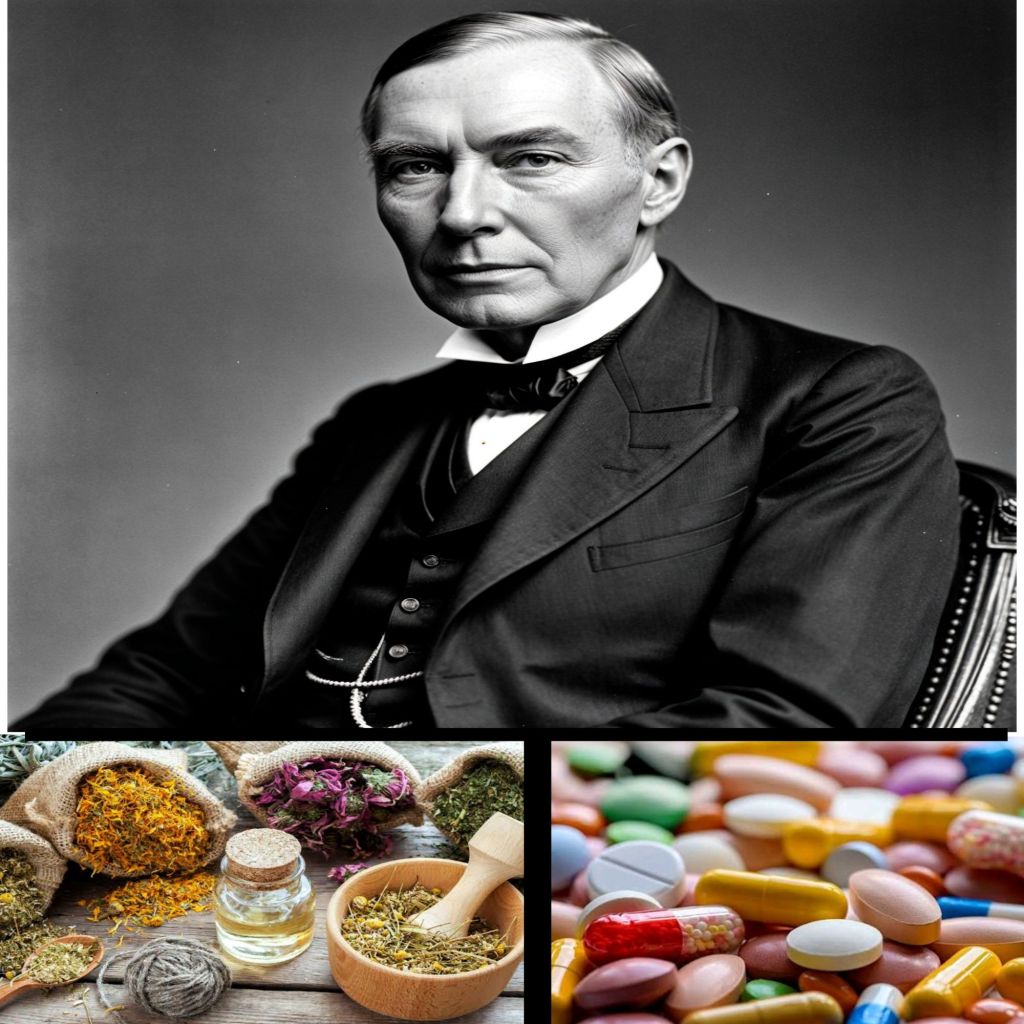
In the labyrinth of pharmaceutical history, few stories are as intriguing—or as misunderstood—as the claim that a single oil tycoon invented synthetic drugs to profit from petroleum byproducts, condemned herbal medicine, and secretly relied on homeopathy for his own health.
This popular narrative, often linked to John D. Rockefeller, suggests that he turned unused oil materials into medicines, used his power to suppress natural healing, and promoted synthetic drugs to the public. But how much of this story is grounded in fact, and how much is modern myth? Let’s separate history from speculation.
—
🌿 The Birth of Synthetic Drugs
Synthetic drugs are man-made chemical compounds designed to mimic or enhance natural substances. Their emergence transformed medicine by making treatments more potent, stable, and mass-produced.
The first true synthetic drug was acetylsalicylic acid (aspirin), created in 1897 by Felix Hoffmann, a chemist at Bayer. This marked the beginning of modern pharmaceutical chemistry—long before Rockefeller’s influence on medicine became significant.
—
🛢️ The Oil Industry and Pharmaceuticals
The myth’s central claim is that Rockefeller used unused oil byproducts to create synthetic drugs. Historically, there is a kernel of truth here: petrochemicals—chemicals derived from crude oil, such as benzene and toluene—eventually became building blocks for many pharmaceuticals, dyes, and plastics.
However, this is not the same as “turning leftover oil into drugs.” Creating pharmaceuticals involves complex organic chemistry, not simple repurposing of oil waste. Rockefeller himself was not a chemist or inventor. His role was financial and strategic, not scientific.
—
🏫 The Flexner Report and the Decline of Herbal Medicine
Where Rockefeller’s influence was truly felt was in medical education, not in the laboratory. In 1910, the Flexner Report, funded by the Carnegie Foundation and supported by Rockefeller interests, evaluated U.S. medical schools.
The report led to a sweeping reform of medical education, emphasizing biomedical science and standardized practices. As a result, many schools teaching homeopathy, naturopathy, and herbal medicine lost funding or closed.
This historical shift is often exaggerated into a conspiracy that Rockefeller “banned herbal medicine.” In reality, the changes favored biomedicine and marginalized alternative approaches—but herbal medicine was not outlawed.
—
🧍 Rockefeller’s Personal Use of Homeopathy
Adding to the confusion is the claim that Rockefeller used homeopathy for his family while promoting synthetic drugs to the public. This part contains a sliver of truth: Rockefeller lived to age 97 and reportedly consulted homeopathic doctors later in life.
However, this was a personal health choice, not an official policy. He also funded biomedical research extensively. The contradiction between public funding of modern medicine and private alternative use has helped fuel the myth.
—
🔬 Real Pioneers of Synthetic Medicine
To understand the real origins of synthetic drugs, we must look to chemists and scientists, not oil tycoons:
🧪 Felix Hoffmann (Bayer): Synthesized aspirin in 1897.
🧬 Alexander Fleming: Discovered penicillin in 1928, which later inspired synthetic antibiotics.
🧠 Countless organic chemists in the early 20th century built pharmaceutical compounds using advanced petrochemical chemistry—not crude oil waste.
None of these figures were oil magnates, nor did they publicly condemn herbal medicine.
—
🧠 The Truth Behind the Myth
The Rockefeller story endures because it blends real historical events with speculative claims:
Element of the Story What’s True What’s False or Exaggerated
Oil used in medicine Petrochemicals became chemical building blocks Drugs weren’t made by “recycling oil waste”
Rockefeller’s role Funded medical education reforms He didn’t invent synthetic drugs.
Herbal medicine suppression Herbal schools lost prominence after Flexner Report Herbal medicine wasn’t “banned”
Personal homeopathy use Rockefeller reportedly used homeopathy personally There’s no conspiracy behind it.
—
✅ Conclusion
The story of Rockefeller inventing synthetic drugs to destroy herbal medicine is a modern myth built around fragments of historical truth. Synthetic drugs were pioneered by chemists like Felix Hoffmann, not oil tycoons. While petrochemicals played a role as raw materials, they weren’t a secret weapon to replace herbs overnight.
Rockefeller’s influence lay in shaping medical education, not in inventing drugs. Herbal medicine declined in mainstream institutions due to policy and educational shifts, not because it was outlawed.
Understanding these facts allows us to appreciate the real history of medicine—a complex interplay between science, industry, culture, and personal beliefs—not a single villain’s plot.
 Tashbaan Herbal Healthcare